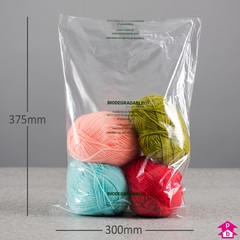
POLYBAGS offers an environmentally friendly
solution by using ‘COMPOBAG’ which will degrade in the
home compost heap with its contents.
Help nature; turn your waste into a valuable fertiliser using our COMPOBAG
Understand degradation process - OXO-DEGRADABLE
This type of plastic decomposes in two stages. Firstly, the material
starts to break down as soon as it is exposed to heat, light and/or
stress.
Then after a certain point, (when the molecular weight is less than
40,000 daltons) bacteria and fungi will start to eat the plastic,
reducing it to carbon dioxide, water and some biomass.
Polybags COMPOBAG’s are made from Oxo-degradable plastics.
How it works?
| · The line on the right represents a polyethylene
molecule with a molecular weight of up to 300,000 . |
 |
| · These lines represent fragments (average molecular
weight of up to 100,000) of the above polyethylene molecule after
some oxidative degradation. |
 |
| · These shorter lines represent even smaller fragments
(molecular weight of up to 30,000) of the original polyethylene
molecule after further oxidative degradation. Although they are
still much too large to be water soluble, some are starting to
biodegrade. Common micro-organisms covert these fragments to
carbon dioxide, water and bio-mass. |
 |
Properties of Compobag:
- Ideal for home compost heaps
-
stores without degrading
-
COMPOBAG is 100% biodegradable
- for the easier segregation of kitchen food waste
- makes the daily tasks of waste reduction easier, safer and better
for the environment
- COMPOBAG will break down into carbon dioxide (CO2) and water
- retains the physical properties, functionality and appearance
of the bags until you put it on your compost heap
Fast Composting tips:
- A sunny
spot is best for compost heaps
- Add some soil or finished compost
- Stir once a week
- Let the air get into compost heaps
- If compost is too dry add some water as micro-organisms need
some moisture to work efficiently
- Manage a good mixture of kitchen and garden waste
- Add activators if possible: compost worms, urine, chicken & pigeon
manure etc. .
|